
Valve released the March 2026 CS2 ammo magazine remodel update on March 22, introducing a comprehensive overhaul of Counter-Strike 2 ammunition reserves and magazine capacities across the entire weapon roster. This major CS2 update fundamentally restructures how players manage ammunition economy and reload discipline by adjusting magazine sizes and reserve ammo availability for rifles, pistols, SMGs, heavy weapons, and sniper rifles. The patch applies immediately across all CS2 game modes—Competitive, Premier, Wingman, and Casual—forcing players at every skill level to rethink spray patterns, economy management, and tactical positioning.
CS2 Magazine and Ammo Changes: What’s Different Across Weapon Classes
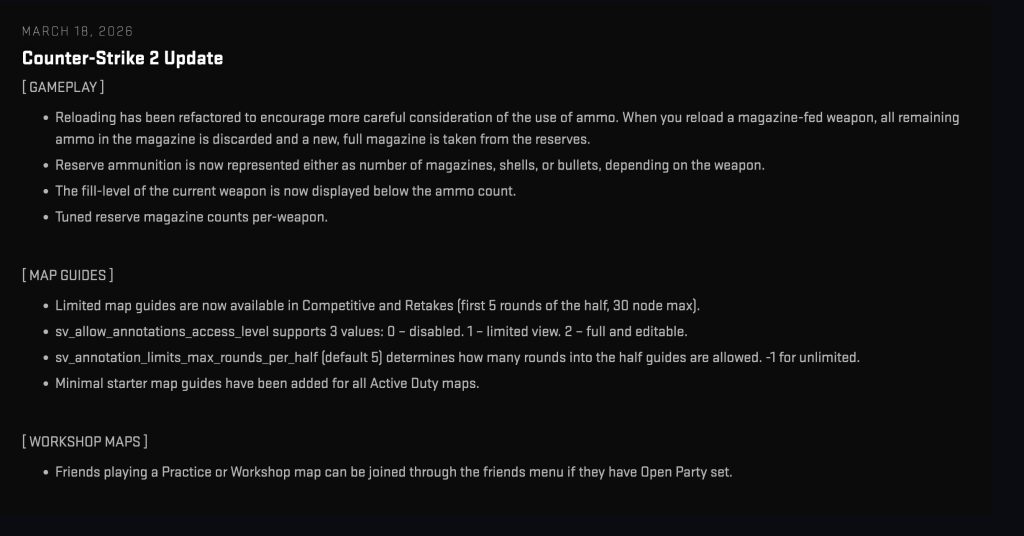
The update affects rifles, pistols, submachine guns, heavy weapons, and sniper rifles with varying degrees of mechanical change. Rifle adjustments are the most visible to competitive players: the M4A1-S magazine has been reduced to 20 rounds, increasing reload frequency for the CT-side weapon. The AK-47, M4A4, FAMAS, and Galil AR all received adjustments to both magazine size and reserve ammo totals, creating more distinct economic profiles for each option.
Pistol round dynamics have shifted significantly. Reserve ammunition for the Desert Eagle, USP-S, Glock-18, and P250 has been reduced, placing greater tactical value on each individual round fired during early-round pistol economies. This change rewards disciplined shot placement and punishes spray-and-pray approaches in the critical opening rounds where individual pistols set the tone for entire map rounds.
The submachine gun class remains largely intact. The P90’s signature 50-round magazine has been preserved, signaling that Valve views the weapon’s magazine capacity as fundamental to its identity. The MP9 and MP5-SD see minor reserve ammo reductions, maintaining their roles as supporting weapons in coordinated play.
CS2 AWP and Sniper Rifle Changes: The Most Aggressive Rebalance
Sniper rifles experienced the most aggressive reserve ammo reductions of any weapon class in the update. The AWP, the most expensive and highest-skill weapon in Counter-Strike, has been reduced from 30 total rounds to 20 rounds. This change directly impacts late-round economics: teams must now manage AWP reserves more carefully, and missed shots in crucial moments carry heavier economic consequences for full squad losses.
The SSG 08, SCAR-20, and G3SG1 all see reduced reserve ammunition, forcing teams to commit more deliberately to sniper-oriented economy rounds. The broader implication is clear: Valve is signaling that sniper weapons should feel scarce and require greater tactical commitment from teams using them.
The Negev and M249 heavy weapons received more targeted adjustments. The Negev’s magazine has been expanded slightly to reward suppression play and area denial strategies. The M249’s reserve ammunition has been trimmed, further differentiating the two heavy weapon options and their intended roles within team compositions.
CS2 Ammo Visual Remodel: New Weapon Magazine and Cartridge Models
The update’s mechanical changes are accompanied by a visual overhaul that Valve integrated into CS2’s physically-based rendering pipeline. All magazines and cartridges received new high-resolution models that reflect more realistic ammunition types and magazine designs across the weapon roster. Ammo pickup animations have been redesigned to feel more grounded and tactile, improving the visual feedback when players scavenge ammunition from fallen teammates.
Most notably, magazine drop-on-reload animations are now visible in first-person view for select weapons: the AK-47, M4A4, and AWP. This marks the first time in Counter-Strike history that players see magazines physically eject during reloads in first-person perspective. The addition enhances immersion while providing subtle visual cues about reload timing and animation length for skilled players learning the new weapon timings.
First-person view of AK-47 reload animation showing magazine drop-on-eject, Counter-Strike 2 rendering
Economic Implications: How the Changes Reshape Round Dynamics
The AWP reserve ammo reduction from 30 to 20 rounds creates cascading effects throughout tournament and ladder play. Teams that lose a mid-round buy and attempt a full eco cannot safely field an AWP without running out of ammunition before securing a plant and executing a post-plant hold. This forces more deliberate AWP buy decisions and punishes passive play where snipers camp for extended periods without fragging.
Pistol round changes shift the metagame at both casual and professional levels. Players cannot rely on spraying reserve pistol ammunition as a backup plan. Each round fired in pistol economies now carries greater weight. On CT side, the M4A1-S magazine reduction to 20 rounds incentivizes even more disciplined single-fire engagement, amplifying the weapon’s existing design philosophy of rewarding precision over volume.
The combined effect across all weapon classes is a game where reserve ammunition scarcity creates pressure. Teams must either frag successfully to collect enemy weapons or commit stronger buy rounds earlier than before. Clutch situations with limited ammunition become higher-tension moments, and players managing their remaining rounds become tactically relevant in a way the previous system did not emphasize.
Community Response to the CS2 Ammo Update: Pro vs. Casual Divide
Competitive players and professional analysts have been broadly positive about the sniper rifle and pistol changes. The sentiment among high-level teams is that the AWP reserve reduction increases skill differentiation: players who consistently land shots will fare better under the new system than those relying on ammunition depth. Pistol changes are similarly viewed as rewarding individual aim and crosshair placement.
The casual community response has been more divided. The M4A1-S magazine reduction has drawn criticism from some casual players who argue it makes the weapon less accessible for learning spray patterns and map control. The sentiment suggests some players view the change as overly aggressive for non-competitive audiences. Valve has not signaled whether balance adjustments will target different player populations separately or remain global across all game modes.
Pro players and analysts have begun preliminary economic impact assessments. BLAST Open Spring 2026, scheduled to begin after the March 22 update in Rotterdam, will be the first major tournament to feature the updated weapon economics. The tournament will provide real-world data on how the changes affect championship-level play at buy decision stages and how teams adapt their economy models to accommodate reduced ammunition availability.
What’s Next: Expected Hotfixes and Tournament Impact
Valve has not signaled additional weapon balance changes in the same patch cycle, but the studio has historically deployed hotfixes when competitive data reveals unintended imbalances or dominant strategies. If specific weapon options prove too weak or too strong in tournament play over the coming weeks, expect minor reserve ammunition or magazine size adjustments to follow.
BLAST Open Spring 2026 will be the critical test environment for the new ammunition system. Teams competing in Rotterdam will need to quickly adapt their economy models and buy decisions to account for the reduced reserves, and professional broadcasters will likely spend considerable analysis time explaining the new weapon economics to viewers unfamiliar with the specifics of the changes.
The CS2 ammo magazine remodel represents one of the most substantial mechanical shifts to Counter-Strike’s economy and gunplay since launch. The March 2026 update fundamentally changes how teams manage ammunition scarcity and economy discipline across all skill levels. Follow NerdHouse for continuing coverage of how professional teams adapt to the CS2 weapon balance changes, tournament impact reports from BLAST Open Spring 2026, and deep-dive analysis of the long-term competitive implications of this major ammunition and magazine overhaul.