
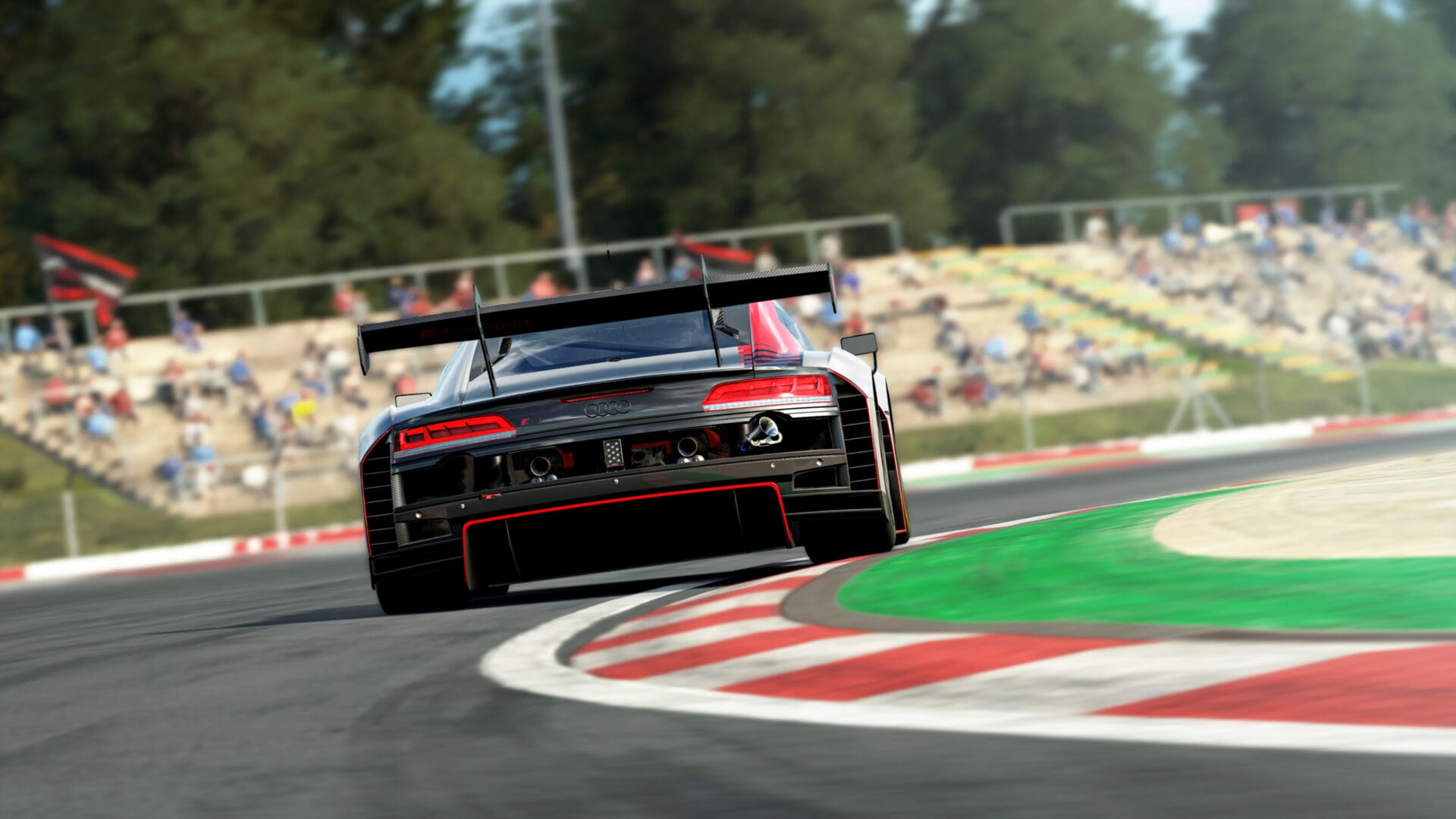
Assetto Corsa EVO Early Access 0.7 is now live with one of the most strategically significant updates of the early access programme to date. This sim racing update introduces the official SDK for car editing, a brand-new particle system for smoke, dust, spray and impact effects, four new competitive vehicles including the iconic Datsun 240Z and Porsche 935, and broad improvements across the renderer, audio, physics engine, multiplayer infrastructure, and user interface.
Four New Vehicles Expand the Roster
This update adds four vehicles that span both contemporary GT racing and automotive history. The Audi R8 LMS GT3 Evo II represents the cutting edge of modern customer racing with mature aerodynamic balance, predictable rotation characteristics, and mechanical honesty that rewards consistency. The vehicle serves as a benchmark for modern GT3 driving dynamics.
The Datsun 240Z returns to the sim in two distinct variants. The classic Japanese sports car features traditional long-hood proportions, an inline-six engine character, and mechanical purity representative of its era. One variant remains in stock form, while the second offers a more focused setup ideal for cornering exploration and analogue driving feel.
Porsche representation expands with two complementary additions. The Porsche 935, a modern tribute built on the GT2 RS Clubsport platform and clothed in the unmistakable long-tail bodywork of the original 935, delivers dramatic aerodynamics and strong character presence. The Porsche 911 GT2 RS Clubsport Evo Kit represents the track-only ultimate evolution of the 991 generation, featuring turbocharged performance, serious downforce, and demanding rear-engine dynamics that reward precision and commitment.
Official SDK Release Enables Community Content Creation
User-generated content has been integral to Assetto Corsa’s identity since launch. The original game’s community built an extensive ecosystem of vehicles and tracks that expanded the sim far beyond its stock roster. This update officially brings this legacy to EVO with the first SDK release, designed for the technically skilled creators who established Assetto Corsa’s reputation as the most extensible racing simulation on the market.
The SDK provides car editor tools closely aligned with those used internally by the development team, ensuring authentic compatibility with the physics model and renderer. Unlike the original Assetto Corsa editor, the new SDK features a modern, complete production pipeline including Physically Based Rendering (PBR) material production, full Level of Detail (LOD) management, and support for aftermarket components with both visual and mechanical variants that can be applied as user-created upgrades.
The first release focuses exclusively on the car editor. Custom livery and track editing tools are scheduled for future updates. User-generated cars are currently playable in Single Player modes, with Multiplayer support targeted for a subsequent update alongside custom liveries.
Brand-New Particle System Enhances Visual Fidelity
This release introduces a comprehensive particle system, one of the most requested visual effects since development began. The new particle system now renders tyre smoke accompanying wheelspin, slides, and drift work with proper intensity. Dirt and dust kick up realistically when vehicles run across gravel, grass, or off-circuit edges.
Spray effects build correctly in wet conditions, adding environmental feedback to driver inputs and track conditions. Impact and crash effects add weight and consequence to hard moments on track, enhancing the visual representation of contact severity. The new particle effects are enabled by default, with a fallback video setting available for lighter hardware configurations that prioritize performance.
Safety Rating System Arrives on Daily Racing Portal
This release debuts EVO SR (Safety Rating) on the Daily Racing Portal. Drivers gain rating by running in close company with other vehicles without making contact. The system reads contacts directly from physics impact data, with aggressors penalized and victims protected through a smoothly scaling severity model.
The Safety Rating system features five tier levels: Rookie, D, C, B, and A. Drivers begin at the Rookie tier, with progression to the top A tier earned through consistent, clean racing rather than passive advancement.
Renderer, Audio, and Physics Refinements
The renderer receives substantial improvements in this update. A refactored texture streaming pipeline, now driven by GPU feedback, enhances memory efficiency and visual quality. A new texture quality option in video settings grants players direct control over visual fidelity. Lighting and shading fixes include proper handling of indirect specular contribution in shadow areas, accurate cloud shadow tracking aligned with the sky dome, and fog formulation consistency across cubemaps and mirrors aligned to the volumetric lighting pass.
Audio enhancements focus on vehicle authenticity. The Lotus Exige V6 features brand-new interior sound design. The Toyota Supra RZ receives a complete sound overhaul covering interior acoustics, exterior notes, custom turbo spooling, and custom backfire behavior. The Toyota Supra drift variant undergoes full engine rework including revised turbo characteristics, rev-limiter rumble, stabilized drivetrain wobble, and adjusted boost pressure mapping. The FMOD audio middleware library receives an update to the latest version, and horn sounds receive a comprehensive refresh across all vehicles.
Physics updates address vehicle balance and handling characteristics. The BMW M3 E30 and Mercedes-Benz 190E receive comprehensive balancing passes. The BMW M3 E46 gets engine inertia tweaks. The Toyota GR86 receives a refreshed default setup. The Volkswagen Golf 8 GTI sees adjusted power figures. A critical caster adjustment bug fix resolves issues affecting certain new suspension configurations.
Multiplayer and UI Enhancements
Multiplayer infrastructure and user interface improvements enhance the overall experience. Results dumps now carry mechanical variant information and Performance Index data for statistical tracking. A new tuning filter streamlines setup customization workflows. The restart-session command now repairs all vehicles automatically, reducing friction in practice sessions.
The car specifications sheet is now available on the mechanical variant selection screen, allowing drivers to review detailed vehicle data before committing to a setup. A new on-the-fly binding system allows drivers to disable the H-shifter in favor of sequential shifting without leaving the active session. Car number plates now correctly reflect player-selected choices in multiplayer servers. Gameplay logic and core architectural code received comprehensive revision to improve stability and consistency.
Additional stability improvements address delta time handling when paused and replay movable object interpolation. These foundational fixes strengthen the simulation’s core engine reliability across all gameplay modes.
What’s Next
This update represents a substantial step forward in the EVO development roadmap, with the official SDK release opening the door to community content creation and the particle system establishing visual standards for immersion. Future updates are expected to deliver custom livery tools, track editing capabilities for the SDK, and Multiplayer support for user-generated content.
The Safety Rating system’s debut on the Daily Racing Portal suggests ongoing refinement to the competitive racing infrastructure. Players eager to engage with community creation tools should review the official AC EVO documentation, while drivers focused on online competition can begin establishing their Safety Rating profile.